During my time at DNSimple, I made three web comics to explain DNS, HTTPS, and DNSSEC to people who didn’t already understand them. I’m a visual person, and I’ve always liked communicating with diagrams, drawings, and arrows. Back in the day, buying a few Manga Guides from No Starch Press, obsessing over Why’s (poignant) guide to Ruby and The Dvorak Zine showed me how well the format could handle a complex subject.
When I started working with DNS and domain management, I found that most explanations either assumed some prior knowledge or buried the reader in detail. I wanted to see whether comics could make these systems easier to understand without misrepresenting how they work.
The hard part was keeping a balance between simplicity and being exhaustive. Simplify too little and you’ve recreated another dense explanation with nicer fonts. Simplify too much and you’ve taught someone something that’s wrong. Cutting detail without introducing misconceptions meant being deliberate about which details mattered and which didn’t.
Instead of starting with definitions, for the DNS comic, I told a story about a message that needs to arrive safely and the things that can happen to it along the way. I broke each process into discrete steps you could watch happen.
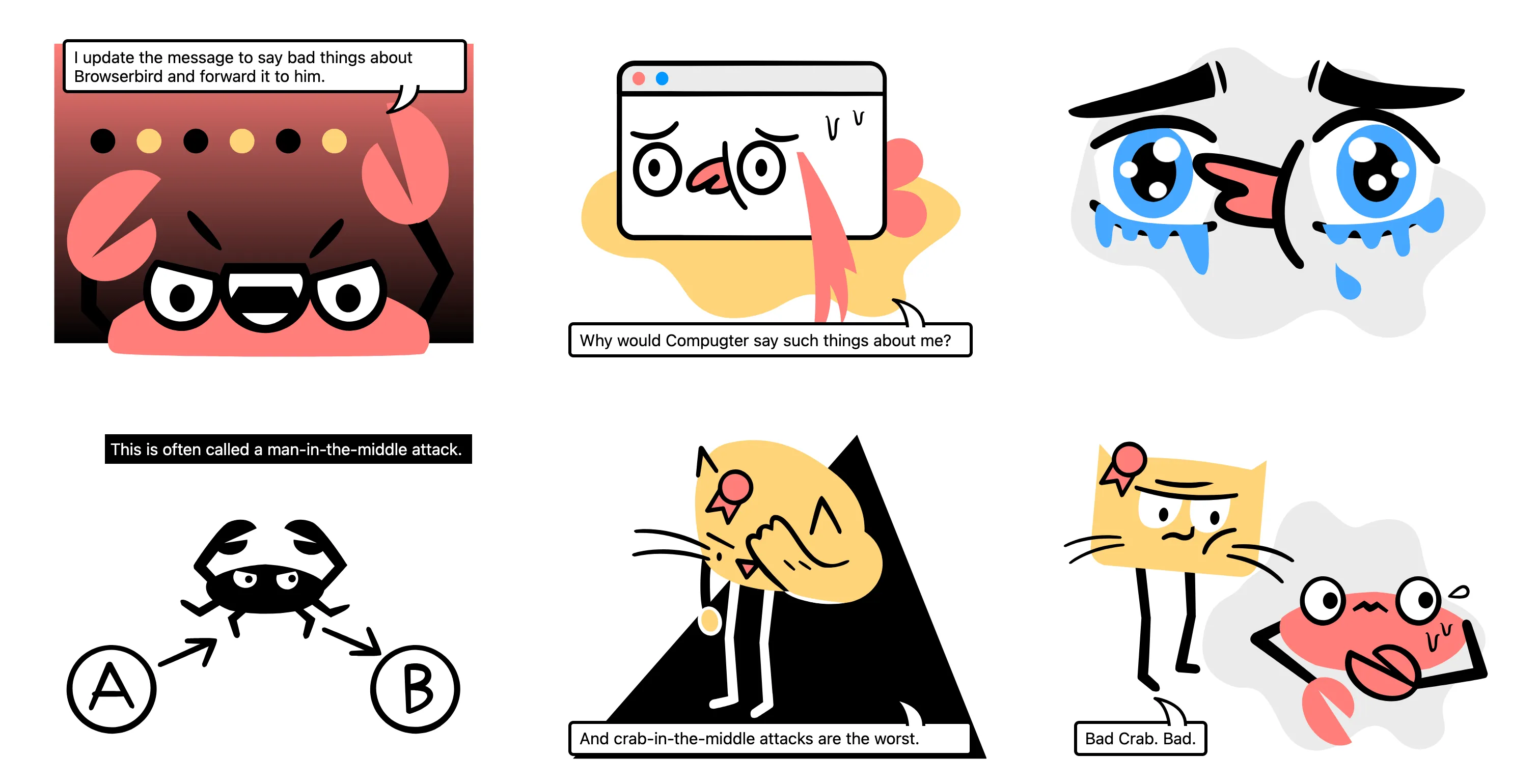
For HTTPS, the threat stays abstract until you can see it. A crab sitting between you and the site, quietly reading and rewriting your messages, makes “man in the middle” something you understand in one glance instead of one paragraph.

For DNSSEC, the whole point is trust. You have to know an answer really came from the source it claims to have come from. So I made an interactive game at the end of the comic. You follow a chain of trust one link at a time while a character asks whether you can prove the answer is authentic.
These went out as microsites: howdns.works, howhttps.works, and howdnssec.works. They took on a life of their own. A few hundred people read them every month, and volunteers translated them into other languages without being asked. The interactive pieces turned reading into doing.
What surprised me was what happened beyond the comics. The characters became part of DNSimple’s voice and branding, appearing on stickers, T-shirts, and even in coloring books. Making the systems easier to understand also gave people a cast of characters they wanted to keep around.
I enjoyed working on these pieces, and I’ll keep exploring topics like these.